Bhimbetka: Prehistoric Rock Shelters and Paintings
Table of Contents
- Location of Bhimbetka
- Name of Bhimbetka
- Why Bhimbetka Was Given UNESCO World Heritage Status
- Who Discovered Bhimbetka?
- Formation of Caves
- Why Was Bhimbetka Occupied for Such a Long Period?
- Age of Occupation
- Paleolithic Paintings
- Mesolithic Paintings
- Chalcolithic and Historic Paintings
- Dyes and Brushes
- Why Did the Paintings Survive for Thousands of Years?
- Blue Pigment and Other Colours
- Comparative Rock Art Traditions
1. Location of Bhimbetka
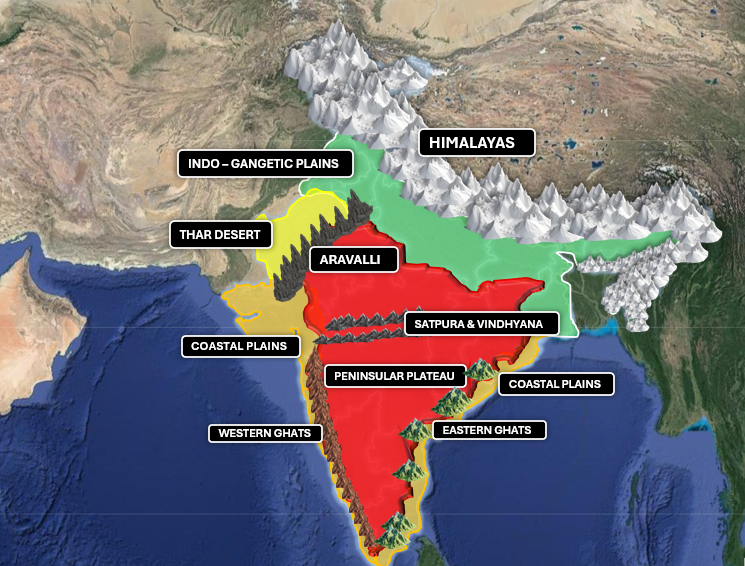
Bhimbetka is one of India’s most important prehistoric archaeological sites.
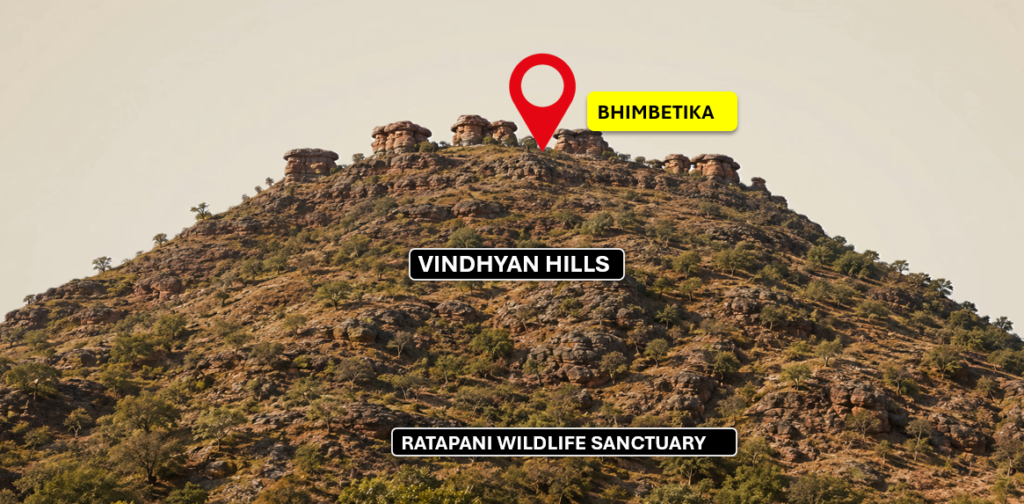
It is located in Raisen district of Madhya Pradesh, in the Vindhyan Hills. The site lies within the Ratangiri/Ratapan(i) Wildlife Sanctuary area
To understand the location properly, it is useful to remember the geographical arrangement of central India:
Vindhyan Range → Narmada River → Satpura Range → Tapi River
The Vindhyan Range lies to the north of the Narmada River, while the Satpura Range lies to its south. Further south is the Tapi River.
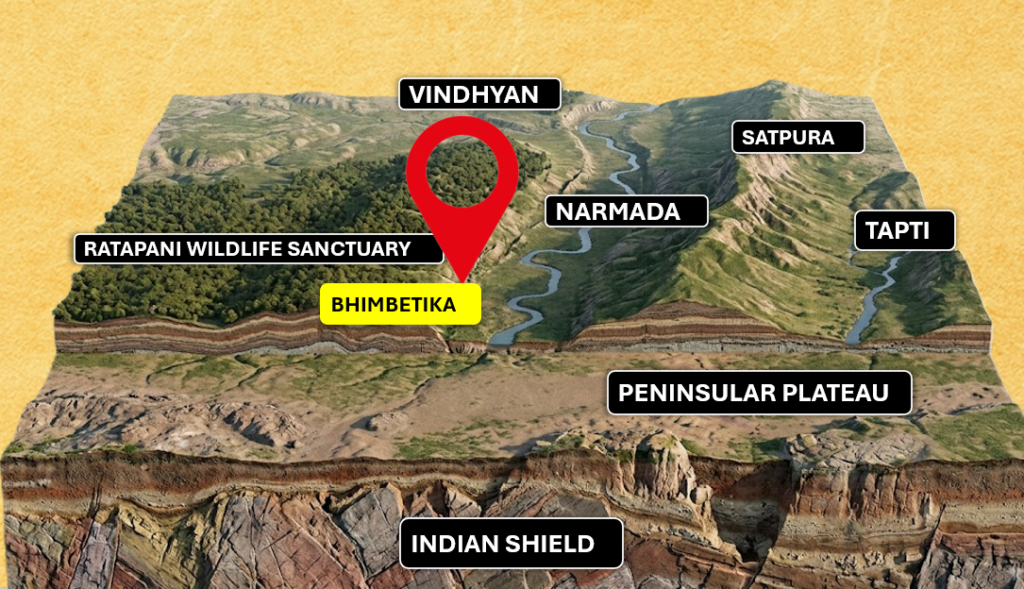
Bhimbetka is located in the Vindhyan region, near the Narmada Valley.
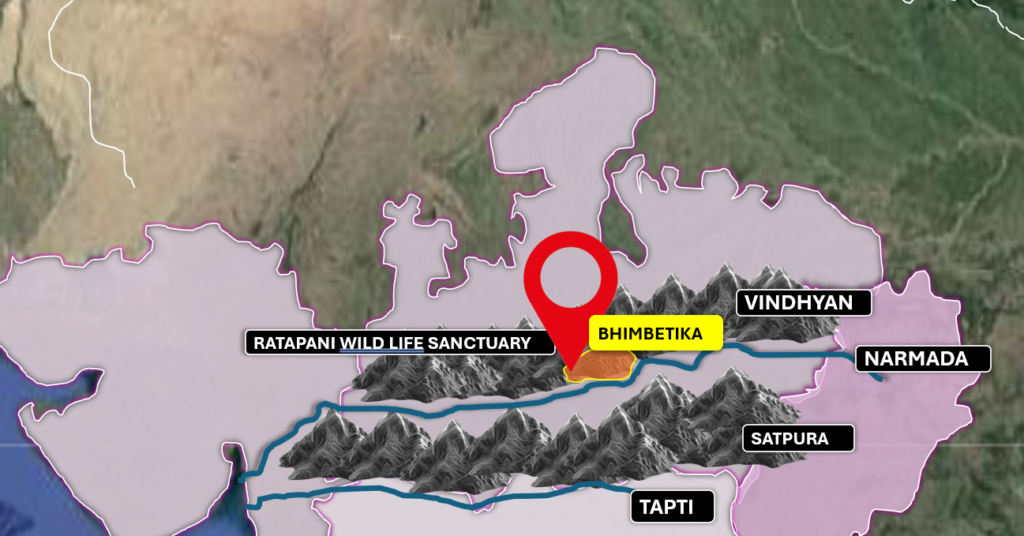
Important geographical features associated with Bhimbetka
- Vindhyan Range
- Narmada River
- Satpura Range
- Tapi River
- Peninsular Plateau
- Indian Shield
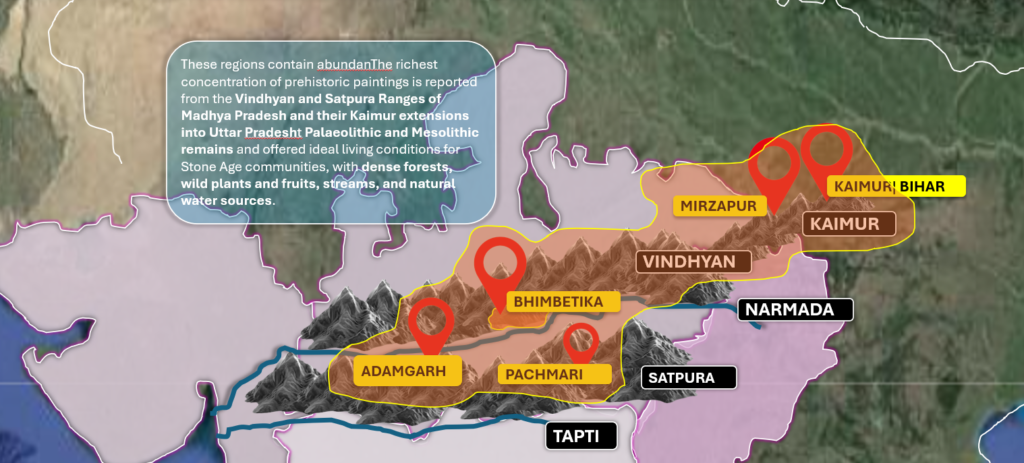
The location becomes especially important for UPSC because several prehistoric sites are concentrated around this broader region.
The Vindhyan Range also extends towards Uttar Pradesh and Bihar. In that extended portion, it is known as the Kaimur Range.
Therefore:
Vindhyan Range → Kaimur Range in its eastern extension
The Kaimur region also contains several prehistoric sites.
Other prehistoric sites associated with this broad region include Adamgarh, Pachmarhi, Mirzapur and Belan Valley.
This concentration of prehistoric sites in the Vindhyan–Satpura–Narmada region is an important geographical feature.
2. Name of Bhimbetka
The name Bhimbetka is traditionally associated with Bhima, one of the major characters of the Mahabharata.
The name is commonly explained as:
Bhima + Baithak = Bhimbetka
The traditional explanation is that Bhima stayed or sat in this area.
The name therefore became associated with the place.
The archaeological site itself is located in the Vindhyan Hills and contains numerous rock shelters and prehistoric paintings.
3. Why Bhimbetka Was Given UNESCO World Heritage Status
Bhimbetka was declared a UNESCO World Heritage Site in 2003.
Bhimbetka is particularly important because it combines:
- Very old prehistoric occupation
- Lower Paleolithic evidence
- Acheulian stone technology
- Long-term human occupation
- Numerous rock shelters
- Prehistoric paintings
- Evidence from several cultural periods
One of the most important features is the long sequence of occupation.
Evidence has been found from:
Lower Paleolithic → Middle Paleolithic → Upper Paleolithic → Mesolithic → Neolithic → Chalcolithic → Historic periods
Thus, Bhimbetka represents a very long history of human occupation.
UNESCO World Heritage Sites in India
The lecture also places Bhimbetka within the broader UNESCO framework.
As mentioned in the as of 2026, India has 45 World Heritage Sites:
| Category | Number |
|---|---|
| Cultural | 37 |
| Natural | 7 |
| Mixed | 1 |
| Total | 45 |
A cultural site is associated with human-made cultural heritage.
A natural site is primarily associated with natural heritage.
A mixed site contains both cultural and natural heritage.
The lecture also highlights the geographical extremes of India’s World Heritage Sites:
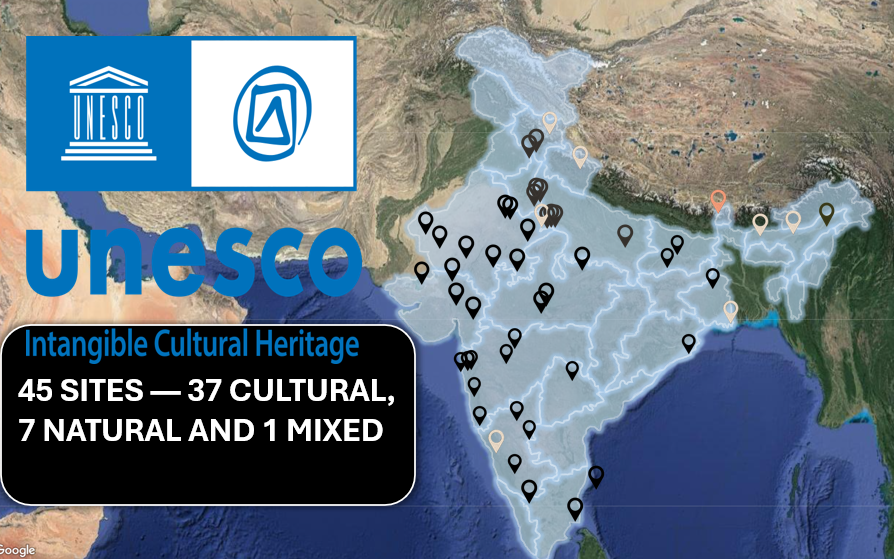
- Northernmost: Great Himalayan National Park, Himachal Pradesh
- Southernmost: Great Chola Temples, Tamil Nadu
- Easternmost: Moidams of Assam
- Westernmost: Dholavira, Gujarat
- Mixed site: Khangchendzonga National Park, Sikkim
- Latest site mentioned in the lecture: Ancient Buddhist Site of Sarnath
The first group of Indian sites inscribed as World Heritage Sites included:
- Ajanta Caves
- Ellora Caves
- Agra Fort
- Taj Mahal
Oldest site in terms of antiquity
The distinguishes between the first sites to be declared and the oldest site in terms of archaeological antiquity.
In terms of antiquity, the Rock Shelters of Bhimbetka are particularly important because they contain prehistoric evidence.
Other UNESCO sites in Madhya Pradesh
The three sites highlighted in the lecture are:
- Bhimbetka
- Sanchi
- Khajuraho
Thus, for UPSC, remember:
Bhimbetka – Sanchi – Khajuraho → UNESCO World Heritage Sites of Madhya Pradesh
4. Who Discovered Bhimbetka?
Bhimbetka was discovered by the archaeologist V. S. Wakankar in 1957.
Wakankar was travelling by train when he noticed the distinctive rock formations of the Vindhyan region.
The landscape attracted his attention.
He suspected that such isolated rock formations could have been associated with prehistoric human occupation.
He investigated the area and discovered the archaeological importance of Bhimbetka.
The site contained:
- Rock shelters
- Stone tools
- Prehistoric occupation evidence
- Rock paintings
The discovery therefore revealed that the area was much more important than simply being a group of natural rock formations.
Other work associated with V. S. Wakankar
The lecture also discusses Wakankar’s association with the study of the Kayatha Culture.
He was also involved in ideas concerning the possible location of the Saraswati River.
The Rig Veda refers to the Saraswati, but its exact geographical location is debated.
Wakankar proposed an interpretation of the Sapta-Sindhu region and attempted to identify the possible drainage basin of the Saraswati.
Thus, V. S. Wakankar is important in the lecture for three major reasons:
Bhimbetka → Kayatha Culture → Saraswati-related archaeological interpretation
5. Formation of Caves
The rock shelters of Bhimbetka are closely related to the geological structure of the region.
The lecture particularly focuses on sedimentary rocks, especially sandstone.
A large number of Lower Paleolithic sites are associated with sedimentary rock environments.
Three major types of rocks
| Rock Type | Examples |
|---|---|
| Igneous | Granite, Basalt, Gabbro, Diorite, Obsidian |
| Sedimentary | Sandstone, Limestone, Shale |
| Metamorphic | Quartzite, Marble, Slate, Gneiss |
Igneous Rocks
Igneous rocks are formed from molten magma.
The basic process is:
Magma → Cooling → Crystallisation → Igneous Rock
As magma cools, minerals crystallise and form rocks.
Examples include:
- Granite
- Basalt
- Gabbro
- Diorite
- Obsidian
Sedimentary Rocks
Sedimentary rocks form from sediments accumulated over long periods.
For example:
Sand → Deposition → Pressure/Compaction → Sandstone
Sand grains accumulate over time.
Pressure causes the grains to become compacted and eventually form solid rock.
Examples include:
- Sandstone
- Limestone
- Shale
Metamorphic Rocks
Metamorphic rocks form when an existing rock is subjected to heat and pressure.
The important point is that the original rock does not completely melt.
Instead:
Existing Rock → Heat + Pressure → Recrystallisation/Rearrangement → Metamorphic Rock
For example:
Sandstone → Heat + Pressure → Quartzite
Thus, the three basic processes can be remembered as:
Magma cooling → Igneous
Sediment compaction → Sedimentary
Heat + Pressure without melting → Metamorphic
Rock Shelters of Bhimbetka
The lecture highlights that Bhimbetka has around 700 rock shelters, of which a substantial number contain paintings.
Not all shelters have been excavated.
Only a relatively small portion of the entire archaeological landscape has been systematically excavated and studied.
6. Why Was Bhimbetka Occupied for Such a Long Period?
Bhimbetka is remarkable because different human groups and cultures repeatedly occupied the region.
The site provided suitable rock shelters for habitation.
The surrounding landscape also provided access to resources.
The geographical setting of the Vindhyan Hills, valleys and nearby river systems made the region suitable for repeated occupation.
The most important point is the continuity of occupation.
Evidence occurs across several periods:
Lower Paleolithic
↓
Middle Paleolithic
↓
Upper Paleolithic
↓
Mesolithic
↓
Neolithic
↓
Chalcolithic
↓
Historic Period
The lecture describes Bhimbetka as having an almost continuous sequence of occupation.
The Lower Paleolithic occupation is especially important because it is associated with Homo erectus and Acheulian stone technology.
Later periods are associated with Homo sapiens.
Therefore, Bhimbetka is not simply a site of paintings.
It is a site showing a long archaeological sequence of human occupation.
7. Age of Occupation
The lecture uses the following broad sequence.
Lower Paleolithic
The Lower Paleolithic occupation is associated with Homo erectus.
The lecture gives the broad Lower Paleolithic timeline as approximately:
5 lakh to 1 lakh years ago
Bhimbetka contains evidence of very old occupation associated with this phase.
The important point is that the Lower Paleolithic occupation predates the presence of modern humans in the region discussed in the lecture.
The site contains Acheulian stone technology.
Later Paleolithic and Mesolithic
Later phases saw the presence of Homo sapiens.
The lecture places the arrival of Homo sapiens in South Asia at approximately 65,000 years ago.
At Bhimbetka, later occupation continued through:
- Middle Paleolithic
- Upper Paleolithic
- Mesolithic
- Neolithic
- Chalcolithic
- Mauryan period
- Shunga period
- Later historical phases
The lecture summarises the occupation as extending approximately from 1 lakh years ago to around 2,000 years ago, representing a very long period of occupation.
Important UPSC distinction
Do not assume that the presence of Lower Paleolithic occupation means that the famous paintings were also made during the Lower Paleolithic.
The sequence is important:
Lower Paleolithic → Occupation and stone tools
Upper Paleolithic and Mesolithic → Major development of paintings
Later periods → Continued occupation and later paintings
This distinction is important for understanding Bhimbetka.
8. Paleolithic Paintings
Bhimbetka contains evidence of prehistoric paintings, but the paintings should be understood in relation to the broader occupation sequence.
The Lower Paleolithic phase was associated with occupation and stone tools.
The famous painting tradition developed during later phases, particularly the Upper Paleolithic and Mesolithic periods.
Therefore:
Lower Paleolithic ≠ major painting phase
The paintings began appearing during the later prehistoric phases.
The rock surfaces provided a canvas for prehistoric artists.
The subjects included:
- Animals
- Humans
- Hunting
- Groups of people
- Movement and activities
One important feature is that the paintings provide clues about the life of prehistoric communities.
The artists represented the world around them, particularly animals and human activities.
Animal representations
Animals were an important subject of Bhimbetka paintings.
The paintings include representations of animals such as:
- Bison/wild buffalo
- Deer
- Boar
- Elephants
- Other animals
Some animal figures contain complex internal patterns rather than being represented as simple outlines.
This demonstrates variation in the style and technique of prehistoric artists.
9. Mesolithic Paintings
The Mesolithic period is particularly important for Bhimbetka’s rock art.
During this period, paintings increasingly represented human activities.
One of the important changes is the appearance of scenes showing:
- Hunting
- Dancing
- Groups of humans
- Social activities
- Animals
- Human-animal interaction
Dancing scenes
The lecture specifically highlights dancing sequences in Mesolithic paintings.
Two dancing sequences are shown as examples.
This is significant because human social activities become increasingly visible in the rock art.
The Boar Rock
One important example discussed in the lecture is the Boar Rock.
It contains a representation resembling a boar or wild pig.
The painting is associated with the Mesolithic period, although the lecture places it close to the transition between the Upper Paleolithic and Mesolithic.
The Boar Rock is therefore an important example of prehistoric animal representation at Bhimbetka.
Wild Buffalo/Bison painting
Another painting discussed in the lecture represents a large animal identified as a wild buffalo.
The animal is not represented merely as a simple figure.
It contains complex internal patterns.
This makes it an interesting example of the artistic techniques used by prehistoric painters.
Human figures
Mesolithic paintings increasingly contain groups of humans.
These figures may be shown:
- Hunting
- Moving together
- Dancing
- Interacting with animals
- Participating in group activities
Thus, Mesolithic rock art provides a visual record of prehistoric social life.
10. Chalcolithic and Historic Paintings
Bhimbetka continued to be occupied after the Mesolithic period.
The sequence includes:
Neolithic → Chalcolithic → Mauryan → Shunga → Historic periods
The painting tradition also continued.
Therefore, not all paintings at Bhimbetka belong to one single period.
Different generations added paintings to the same rock surfaces.
Chalcolithic phase
The Chalcolithic phase represents a later stage of occupation.
By this time, communities were experiencing changes in technology and lifestyle.
The archaeological sequence at Bhimbetka therefore extends beyond hunting-gathering communities.
Historic paintings
The historic-period paintings show different subjects and activities.
The lecture gives the example of elephants and people.
Some paintings show people associated with elephants, including figures riding or controlling elephants.
One example shows:
- An elephant
- Two people on the elephant
- A person associated with leading or controlling it
- Another figure carrying a sword
These paintings represent a later historical context.
The elephant scenes are therefore different from the earlier prehistoric hunting scenes.
The lecture also highlights an important social change:
Earlier communities are represented mainly as hunter-gatherers, while later communities could include farming communities and other social groups.
Different communities could exist at the same time.
Thus, the historical paintings help show the changing nature of society at Bhimbetka.
11. Dyes and Brushes
Prehistoric artists did not have modern paints or modern brushes.
They used naturally available materials.
Pigments
Natural mineral pigments were used to produce different colours.
The colour depended on the available mineral material.
Important colours seen in Bhimbetka paintings include:
- Red
- White
- Yellow
- Green
- Blue
The pigments were applied directly to rock surfaces.
Brushes
The brushes were made from natural materials rather than modern manufactured materials.
Simple plant materials such as twigs and fibres could be used to create primitive brushes.
A simple process involved:
Twig selection → Preparation of the end → Application of pigment
The artists therefore used materials that were available in their environment.
The painting process required knowledge of:
- Available pigments
- Suitable rock surfaces
- Application techniques
- Natural tools
12. Why Did the Paintings Survive for Thousands of Years?
One of the most important questions concerning Bhimbetka is why its paintings survived for such a long period.
Several factors are important.
1. Mineral-based pigments
Many prehistoric pigments were derived from minerals.
Mineral pigments can remain relatively stable for long periods.
2. Rock surfaces
The paintings were made directly on rock surfaces.
The stable rock surface provided a long-lasting base for the pigments.
3. Rock shelters
Many paintings were located in sheltered areas.
The shelters reduced direct exposure to environmental conditions compared with completely exposed rock surfaces.
4. Protected surfaces
Some painted surfaces were naturally protected by the structure of the rock.
This helped reduce the impact of weathering.
5. Repeated occupation
Bhimbetka was repeatedly occupied.
Different generations continued to use the same shelters and rock surfaces.
As a result, paintings accumulated over long periods.
Superimposition of paintings
An especially important feature of Bhimbetka is superimposition.
This means that a later painting was sometimes made over an earlier painting.
Therefore, one rock surface can contain:
Older painting → Later painting → Another later painting
This creates multiple layers of artistic activity.
Superimposition is important because it also helps archaeologists understand that the paintings belong to different periods.
It shows that Bhimbetka was not painted only once.
Instead, generations of people returned to the same shelters and added new paintings.
13. Blue Pigment and Other Colours
Different pigments were used to create different colours.
Red
Red is one of the important colours seen in Bhimbetka paintings.
Mineral-based red pigments were widely useful for prehistoric painting.
White
White was also used for figures and designs.
Yellow and Green
Yellow and green pigments were also used in some paintings.
Blue
Blue was comparatively difficult to obtain.
The lecture discusses lapis lazuli as a source associated with blue pigment.
Lapis lazuli was rare and was associated with regions such as Afghanistan.
Therefore, blue pigment was not as easily available as some of the other mineral colours.
This highlights an important point:
Availability of raw materials influenced prehistoric painting.
Artists could use the minerals and natural materials available to them.
14. Comparative Rock Art Traditions
Bhimbetka is one of several important rock-art traditions in India.
The lecture compares Bhimbetka with other examples.
Lakhudiyar
Lakhudiyar is located in Uttarakhand.
Although it is geographically far from Bhimbetka, similarities can be observed between some of the paintings.
However, similarity does not necessarily prove that one tradition directly influenced the other.
The similarity could also be the result of independent development or coincidence.
Sora Art
Sora art is another tradition discussed in comparison with Bhimbetka.
Sora paintings commonly contain:
- Humans
- Animals
- Trees
- Geometric motifs
The themes are associated with spiritual beliefs and rituals.
Sora art has similarities with Bhimbetka in its representation of humans, animals and other elements.
However, Sora developed its own distinctive artistic style.
For example, geometric forms found in Sora art are not necessarily identical to the artistic style seen at Bhimbetka.
Warli Art
Warli is another important Indian artistic tradition.
Unlike Bhimbetka, Warli is a living artistic tradition.
The comparison with Bhimbetka is useful because both traditions use simplified human and animal forms.
Important prehistoric rock-art locations mentioned in the lecture
The lecture also identifies several other Indian locations associated with prehistoric paintings, including:
- Lakhudiyar – Uttarakhand
- Mangani/Mangani area – associated with the Aravalli region
- Mirzapur rock shelters
- Bhimbetka – Madhya Pradesh
- Adamgarh – Madhya Pradesh
- Pachmarhi – Madhya Pradesh
- Kurnool caves
- Edakkal Caves – Kerala
These sites show that prehistoric rock art was not limited to Bhimbetka.
However, among these prehistoric painting sites, Bhimbetka has the UNESCO World Heritage recognition highlighted in this topic.
UPSC Revision: Bhimbetka in One View
| Point | Key Fact |
|---|---|
| Location | Raisen district, Madhya Pradesh |
| Geographical region | Vindhyan Hills |
| Nearby major river | Narmada |
| Southern range | Satpura |
| Further south | Tapi River |
| Extended Vindhyan range | Kaimur Range |
| Discovery | V. S. Wakankar |
| Discovery year | 1957 |
| UNESCO status | World Heritage Site |
| UNESCO year | 2003 |
| Major significance | Long sequence of human occupation + rock art |
| Lower Paleolithic | Homo erectus and Acheulian technology |
| Later phases | Homo sapiens |
| Major painting phases | Upper Paleolithic and Mesolithic |
| Mesolithic themes | Hunting, animals, dancing, human groups |
| Important example | Boar Rock |
| Later paintings | Chalcolithic and Historic periods |
| Rock type emphasized | Sedimentary rock, especially sandstone |
| Rock shelters | 700+ mentioned in the lecture |
| Important feature | Superimposition of paintings |
| Major pigments | Red, white, yellow, green and blue |
| Blue pigment | Associated with lapis lazuli |
| Other rock-art traditions | Lakhudiyar, Sora, Warli |
| MP UNESCO sites highlighted | Bhimbetka, Sanchi, Khajuraho |
The core UPSC sequence
Vindhyan Hills → Bhimbetka → V. S. Wakankar → 1957 → Lower Paleolithic occupation → Acheulian tools → long occupational sequence → Upper Paleolithic/Mesolithic paintings → later Chalcolithic and Historic paintings → superimposition → UNESCO World Heritage Site in 2003